What Were the Experimental Directions Taken by Art During the Renaissance
Introduction
"Light creates space"—this is how fine art theorist and perceptual psychologist Rudolf Arnheim boiled down the essential pregnant of depicting light in paintings (Arnheim, 1974). Nevertheless, space comes along with the possibility of disambiguating the shape of objects, then light also assists the perception of three-dimensional structures. This disambiguation is non very effective as long every bit the location of the light source is unknown or unreliably assessed (Rock, 1983). There are only rare cases where we tin directly observe the source of calorie-free in paintings, east.one thousand., explicitly showing the lord's day as is often done in Van Gogh's Wheat Field series of oil paintings (come across Figure 1A), or past showing a human-fabricated light source such every bit candles in the famous Georges de La Bout paintings (run across Figure 1B). In most other cases nosotros have to infer the low-cal source from the characteristic brightness gradient/shading or, alternatively, rely on the conventions realized in certain art historical contexts (Gerardin et al., 2010). Cavanagh and Leclerc (1989) showed that the assumption of calorie-free coming from above assists the consequent interpretation of shape aspects in a visual scene.
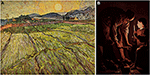
Figure one. (A) Painting "Enclosed field with rising sun" by Vincent van Gogh from the year 1889, explicitly showing the source of light—the sun. (B) Painting "Joseph the Carpenter" by Georges de La Tour from the approximate twelvemonth 1645 explicitly showing the source of light—a candle. Both pictures and their reproductions are in the public domain (Creative Eatables CC-BY license).
Art historian Gombrich, who was very much devoted to perceptual psychology, reported that (Western) artists preferred light from the (pinnacle) left. He identified the simple fact that artists were more often than not right-handers as a major reason for this bias (Lanthony, 1995). This way the cartoon hand does not cake the emitted light (Gombrich, 2002). Gestalt psychologist Metzger's Gesetze des Sehens might be the major source for these claims (Metzger, 1953). The connexion between handedness and the preference for lighting management was empirically shown by Dominicus and Perona (1998) but was challenged by after studies (Mamassian and Goutcher, 2001).
Very early attempts to test for a (top-) left bias of lite sources focused on Western paintings, specifically on Western portraits analyzing specific preferences for the left or right contour (Humphrey and McManus, 1973; McManus and Humphrey, 1973). Coles (1974) demonstrated a articulate bias for the direction of lighting from a left to correct direction in portraits. A recent study on frequencies of leftward vs. rightward depictions in Korean newspapers added to the impression (Lee and Oh, 2015). Korean culture had undergone a direction modify of reading and writing over the last century, from leftward to rightward. The research revealed an ongoing, concordant alter of depictions of drawings, but non of photos, during this catamenia. McManus addressed laterality effects on artworks (McManus, 1979, 2005; McManus et al., 2004). By taking 175 cases of Medieval and Renaissance crucifixions into account, he observed a articulate decline in the number of pictures with the calorie-free straight on or where the low-cal source is depicted rather ambiguously. Farther analyses of the management of light in Renaissance Madonna-and-Kid paintings demonstrated a significant increase in pictures with calorie-free from the right, but nevertheless from 1250 until 1549 A.D. the most frequent direction was from the left (with a number of pictures per bin spanning l years, ranging from 9 to 394). Subsequent work by Mamassian (2008) replicated the general finding of a predominance of left-lit paintings when observing portraits (k = 194) besides as non-portraits (k = 465), selectively employing artworks from the Louvre museum in Paris.
The present study aimed at widening up the view on the documented left bias of Western artworks by expanding the already existing studies. Starting time, McManus's seminal studies focused on very specific creative genres; actually crucifixions and Madonna-and-Kid paintings, which led to the question of how the findings are transferable to other creative topics. Secondly, although McManus took great effort to include many paintings in his studies, the number per time range bin was still conspicuously limited: in some cases k < 10–20 paintings were employed to cover a range of l upwards to 100 (and even 550) years. Tertiary, the origin of the paintings was quite narrow due to the sujets utilized, focusing simply on Italy (i.e., Florentine, Venetian, Central and Northern Italian art). Last but non least, the method of analyzing whether a painting shows a left vs. right (vs. neutral) management of calorie-free source shows and yields clear limitations: (a) It is used in a dichotomous (left vs. correct, Coles, 1974) or tripartite (left vs. right vs. neutral, McManus, 1979) style without further differentiation, (b) descriptions of exactly how the assessment of the direction of the light source was conducted is missing, also bringing into question whether the assessment was checked via observer consensus statistics, and (c) a control condition is missing for checking the base rate of lateral assessment [it could be possible that assessments are already biased due to the knowledge from courses on Western art, where the standard of a pinnacle-left light source is typically taught and taken for granted (Mamassian and Goutcher, 2001; Gombrich, 2005; Stone et al., 2009)].
Therefore, we employed an empirical study where different participants had to assess the direction of the primary low-cal source, painting past painting. We utilized more than ten,000 high-quality depictions of paintings from a broad span of time, representing a major part of Western art history with a richness of themes from all areas of Europe; and so not just from specific regions, painters, epochs, art genres or art galleries. Importantly, we developed a more sophisticated manner of assessing the direction of light source. First, we employed fine art-naïve persons who had to assess the source of lite by drawing the supposed direction of the light beam to gain more fine-graded information. This image, where different persons had to assess the same pictures, also immune united states to test for inter-rater reliability. Second, previous results could have been biased when assessing the laterality of the low-cal source due to mental models of where the light should typically be coming from (actually, as often taught in schoolhouse, "from the top left"). In addition, over time, participants might develop a response bias when being confronted over-representatively frequently with a certain low-cal condition in pictures. Equally a counter-activeness, we decided to mirror half of the presented stimuli horizontally to expose the participants to a mixture of original and reflected images. This enabled us to test for pre-prepare and response biases toward the assessment of the light source and to appraise the reliability of assessments. Third, some paintings are showing more than or less valid cues of low-cal sources. Nosotros were interested in analyzing the factor of unambiguousness by employing an additional mensurate, which asks for the confidence in the calorie-free-source assessment. The master thought behind this was that at a sure period in art history, non just did a specific direction of lite source became standard, just also the ways to show the source became more than sophisticated then more unambiguous over time.
Materials and Methods
Paintings Set
Paintings were all taken from the Wikimedia Commons Yorck Project (https://commons.wikimedia.org/wiki/Category:PD-Art_(Yorck_Project)) and are bachelor under the Artistic Commons Attribution-ShareAlike License. The initial paintings listing consisted of 10,365 entries, merely we excluded any paintings with incomplete meta-information or ones which nosotros failed to acquire via an automatic script. The terminal listing consisted of 9,533 paintings of which nine,469 were presented to observers (paintings were chosen randomly at runtime, hence we faced the state of affairs that some paintings were never selected for estimation, actually k = 64). Artworks were from a broad time interval, spanning from ~1500 B.C. to 2000 A.D., although nigh were created betwixt 1300 A.D. and 1950 A.D. See also Table 1 for the distribution of the paintings' geographical origin.

Tabular array 1. Number of paintings from various locations.
Observers
Seven participants (4 female; M age = 22.seven years, all correct-handed, see Table ii) participated in the measurement. All participants had a normal or corrected-to-normal vision (assessed by a standard Snellen centre chart test) and normal color vision (assessed by a brusque version of the Ishihara color test). Participants were students from the University of Bamberg and received partial course credit for their participation. They had no prior experience with the present task and were naïve to the purpose of this experiment; they did not obtain specific training in art history. All procedures were in accordance with the Announcement of Helsinki. The study was in full accordance with the ethical guidelines of the University of Bamberg and was approved by the university ethics commission on 18 August 2017.

Table 2. Summary for the private observers.
Apparatus
Participants estimated a direction of light in paintings using a custom programme written in Python. Due to the extremely big number of evaluations required from each participant, they were immune to run it on their personal laptops. Settings were adjusted for each private computer to ensure comparable display size across all devices.
Procedure
A screenshot of the plan is depicted in Figure 2A. Participants used a mouse to draw an estimate of the approximate origin and direction of light in the painting (yellow vector in Figure 2B, circumvolve depicts the origin). Paintings were presented either in their original orientation or flipped horizontally to minimize a potential build-up of the response bias (random option with l% of correct and flipped orientation). Accordingly, in the results department we present both raw, uncorrected estimates (as submitted by participants) and mirror-corrected estimates. Viewing time was unlimited and observers were instructed to prioritize accuracy of response over speed. To complete the job, participants indicated their confidence well-nigh the estimate using a one to 7 rating scale (1 = very uncertain, 7 = very sure). Participants had the opportunity to forgo an estimate if they felt that for that specific painting estimating light source was impossible.
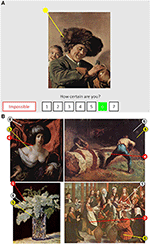
Effigy 2. (A) A screenshot of the experimental program. See text for details. (B) Examples estimates of the approximate management of low-cal in the paintings. Numbers depict participants' confidence.
Statistical Analysis
Data was preprocessed using custom software written in Python. The statistical analysis was carried out using R software (R Core Team, 2017). Linear-mixed modeling was performed using lmerTest package (Bates et al., 2015; Kuznetsova et al., 2016). Binomial confidence intervals were computed via binom package (Dorai-Raj, 2014).
Data Availability
All data files and the code that was used to deport statistical analyses and produce figures for the newspaper are freely available at https://osf.io/t5qfp.
Results and Word
First, nosotros tested for potential biases in assessing the lite source with a unproblematic check-upward of the data: As we randomly (horizontally) mirrored fifty% of the presented pictures we were able to check the overall distribution of assessments, which was nearly perfectly balanced around 0° (meet Figures 3A,C,Due east and Tabular array 2). Chiefly, once the reports were corrected for the mirroring, in that location was a clear and strong preference for observers to report calorie-free the source as being located on the left (see Figures 3B,D,G and Table 2). However, the orientation of estimates relative to the vertical did not depend on whether the estimate was left- or correct-sided (Effigy 3F and Table 2). This pattern of results validates our process and confirms the prior reports of the light in paintings mainly originating from the left.
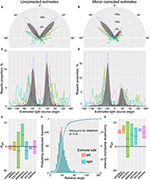
Figure three. The estimated angles of illumination for (A,C) the raw uncorrected estimates and (B,D) the mirror corrected estimates. Plotting conventions: 0° corresponds to the light source beingness positioned direct to a higher place the paintings. Solid lines describe individual observers, gray area depicts the overall group responses. (E,M) Proportion of estimates left off the vertical (P left, mean and 99% binomial confidence interval). (F) Distribution of the relative angle for lite source estimates with light originating on the left and correct side.
With respect to the observers' confidence, we found that they tended to report an estimate merely when beingness confident virtually it (see Effigy 4A, ~80% of trials with an estimate had a confidence rating of four or above, from 1 = min to vii = max). Higher confidence was associated with significantly more consistent estimates across participants, see Effigy 4B. To quantify the effect, we restricted the analysis only to paintings with an estimate from at least three dissimilar participants. Specifically, we fitted a linear model with a standard deviation of estimates for individual paintings as a dependent variable and an boilerplate observers' confidence as a fixed factor. The analysis showed a strong negative relationship, t (745) = −ix.8, p < 0.0001, R two = 0.34, confirming the thought that paintings with richer calorie-free source information led to both higher conviction and more consistent estimates.
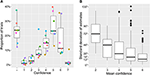
Figure 4. Distribution of conviction reports and observer consistency. (A) The proportion of confidence reports, circumvolve colors denote individual observers. (B) The standard difference of estimates as a function of average reported confidence level (just paintings with estimates from at least three different participants were included in the analysis). College conviction resulted in estimates that were more consistent beyond observers.
We also analyzed for Zeitgeist-dependent positioning of the light source in paintings (we used the approximate dating of paintings with a resolution of 25 years; meet data and statistics Effigy 5). We found that the preferential location of the light source was synchronized with the showtime of the Early Renaissance era, starting at ~1420 A.D. and on through the Cinquecento until the end of the nineteenth century. Our data shows that from the Renaissance on, Western art history had "its bias" to the left regarding the light source. Paintings for which we found clear initial, but too singular, laterality effects were created by Simone Martini (1284–1344), Giotto (1266/1267–1337), and Duccio di Buoninsegna (1255/1260–1318/1319). This is very compatible with the notion of art historians that lighting and shadowing effects were identified every bit a basic and innovative topic of Western art history with the rise of Early Renaissance painters such as Masaccio (1401–1428), Andrea Mantegna (1431–1506), and Andrea del Verrocchio (1435–1488). Of import techniques to realize lighting and shadowing effects were developed during this period; virtually importantly was a technique where strong contrasts between light and dark are used-known equally chiaroscuro (from Italian chiaro, "calorie-free," and scuro, "dark"). Critically, some preliminary works also dealing with clear lighting and shadowing effects could have been covered in the statistical analysis by the mere fact that before 1400 A.D., a comparatively smaller number of paintings were (and are) bachelor (run across Figure 5A). Still, based on participants' confidence (Figures 5B,C), nosotros can clearly country that overall there was no clear and reliable way of positioning the light source before the Early on Renaissance.
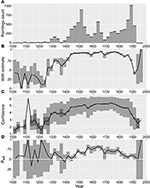
Figure 5. Light source Zeitgeist. (A) Distribution of paintings' creation appointment. Please annotation that paintings created before g A.D. are not shown. (B) The proportion of paintings for which an gauge was possible. (C) Participants' confidence, lighter and darker greyness stripe denote, respectively, standard departure and standard mistake of the hateful. (D) The proportion of the light source direction estimated as originating from the left. Gray stripe denotes 99% binomial confidence interval.
Conclusions
Past employing an extensive set of images of very unlike sujets of Western art history, nosotros take compiled articulate and unbiased bear witness that within the period 1420–1900 A.D., painters preferred to pigment the low-cal source from the top left. This issue, based on participants' estimates, was complemented by the participants' confidence in their estimates. Fin de siècle ended this 500-year-long dominance in art history, opening new avenues of artistic depictions of lite, contrast, and depth.
Author Contributions
CCC had the initial idea; CCC and AP contributed conception and blueprint of the written report; AP programmed the procedure; AP performed the statistical analysis; CCC and AP wrote the outset draft of the manuscript. All authors contributed to manuscript revision, read, and approved the submitted version.
Conflict of Interest Argument
The authors declare that the inquiry was conducted in the absenteeism of any commercial or financial relationships that could be construed as a potential disharmonize of interest.
References
Arnheim, R. (1974). Fine art and Visual Perception: A Psychology of the Creative Heart. Berkeley, CA: University of California Press.
Bates, D., Mächler, G., Bolker, B., and Walker, Due south. (2015). Fitting linear mixed-effects models using {lme4}. J. Stat. Softw. 67, 1–48. doi: 10.18637/jss.v067.i01
CrossRef Full Text
Gerardin, P., Kourtzi, Z., and Mamassian, P. (2010). Prior knowledge of illumination for 3D perception in the homo encephalon. Proc. Natl. Acad. Sci. U.Due south.A. 107, 16309–16314. doi: ten.1073/pnas.1006285107
PubMed Abstruse | CrossRef Full Text | Google Scholar
Gombrich, East. H. (2002). Art and Illusion: A Written report in the Psychology of Pictorial Representation, 6th Edn. London: Phaidon Printing.
Gombrich, Eastward. H. (2005). The Story of Art, 16th Edn. London: Phaidon.
Humphrey, Northward. K., and McManus, I. C. (1973). Status and the left cheek. New Sci. 23:437.
Google Scholar
Kuznetsova, A., Bruun Brockhoff, P., and Haubo Bojesen Christensen, R. (2016). lmerTest: Tests in Linear Mixed Effects Models. Bachelor online at: https://cran.r-project.org/parcel=lmerTest
Lanthony, P. (1995). Les peintres gauchers. Rev. Neurol. (Paris). 151, 165–170.
Google Scholar
Lee, H., and Oh, S. (2015). How directional alter in reading/writing habits relates to directional change in displayed pictures. Laterality 21, one–11. doi: 10.1080/1357650X.2015.1047782
PubMed Abstract | CrossRef Total Text | Google Scholar
McManus, I. C. (1979). Determinants of Laterality in Man, Unpublished Ph.D. thesis, University of Cambridge.
Google Scholar
McManus, I. C. (2005). Symmetry and asymmetry in aesthetics and the arts. Eur. Rev. thirteen, 157–180. doi: 10.1017/S1062798705000736
CrossRef Total Text | Google Scholar
Metzger, W. (1953). Gesetze des Sehens (Laws of Vision), 2nd Edn. Frankfurt: W. Kramer.
R Core Team (2017). R: A Language and Environment for Statistical Computing. Available online at: https://www.r-projection.org/
Rock, I. (1983). The Logic of Perception. Cambridge, MA: Bradford.
Google Scholar
Stone, J. Five., Kerrigan, I. S., and Porrill, J. (2009). Where is the light? Bayesian perceptual priors for lighting direction. Proc. Biol. Sci. 276, 1797–1804. doi: x.1098/rspb.2008.1635
PubMed Abstract | CrossRef Full Text | Google Scholar
Source: https://www.frontiersin.org/articles/10.3389/fpsyg.2018.00454/full
0 Response to "What Were the Experimental Directions Taken by Art During the Renaissance"
Post a Comment