what can low income countries do in order to increase the amount of loanable funds
Chapter 32. Macroeconomic Policy Around the Earth
32.2 Improving Countries' Standards of Living
Learning Objectives
By the end of this section, you volition exist able to:
- Clarify the growth policies of depression-income countries seeking to amend standards of living
- Analyze the growth policies of middle-income countries, particularly the East Asian Tigers with their focus on technology and market-oriented incentives
- Analyze the struggles facing economically-challenged countries wishing to enact growth policies
- Evaluate the success of sending assist to low-income countries
Jobs are created in economies that abound. Where does economic growth come from? According to nearly economists who believe in the growth consensus, economical growth (as discussed in Economic Growth) is built on a foundation of productivity improvements. In turn, productivity increases are the result of greater homo and physical capital and technology, all interacting in a market-driven economic system. In the pursuit of economical growth, however, some countries and regions start from different levels, equally illustrated by the differences in per capita GDP presented before in Table ii.
Growth Policies for the High-Income Countries
For the loftier-income countries, the challenge of economic growth is to push continually for a more than educated workforce that can create, invest in, and apply new technologies. In effect, the goal of their growth-oriented public policy is to shift their amass supply curves to the right (refer to The Aggregate Demand/Amass Supply Model). The principal public policies targeted at achieving this goal are fiscal policies focused on investment, including investment in human capital letter, in engineering science, and in physical plant and equipment. These countries also recognize that economic growth works best in a stable and market-oriented economic climate. For this reason, they use monetary policy to go on inflation depression and stable, and to minimize the gamble of exchange rate fluctuations, while also encouraging domestic and international competition.
Still, early in the second decade of the 2000s, many high-income countries plant themselves more focused on the curt term than on the long term. The United States, Western Europe, and Nihon all experienced a combination of financial crisis and deep recession, and the after-furnishings of the recession—like high unemployment rates—seemed likely to linger for several years. Almost of these governments took aggressive, and in some cases controversial, steps to leap-offset their economies by running very large budget deficits as role of expansionary fiscal policy. These countries must adopt a form that combines lower authorities spending and higher taxes.
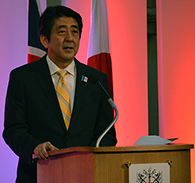
Similarly, many central banks ran highly expansionary monetary policies, with both near-zero involvement rates and unconventional loans and investments. For instance, in 2012, Shinzo Abe (see Figure 1), then newly-elected Prime number Minister of Nihon, unveiled a plan to get his country out of its two-decade-long slump in economic growth. It included both fiscal stimulus and an increment in the money supply. The programme was quite successful in the curt run. Even so, co-ordinate to the Economist, with public debt "expected to arroyo 240% of Gdp," (every bit of 2012 it was 226% of GDP) printing money and public-works spending were only brusque-term solutions.
As other capacity discuss, macroeconomics needs to take both a short-run and a long-run focus. The challenge for many of the developed countries in the next few years will be to get out from the brusk-term policies that were used to correct the 2008–2009 recession. Since the return to growth has been sluggish, information technology has been politically challenging for these governments to refocus their efforts on new technology, educational activity, and physical upper-case letter investment.
Growth Policies for the Heart-Income Economies
The earth's cracking economical success stories in the last few decades began in the 1970s with that group of nations sometimes known equally the E Asian Tigers: Republic of korea, Thailand, Malaysia, Republic of indonesia, and Singapore. The list sometimes includes Hong Kong and Taiwan, although these are frequently treated under international law as role of China, rather than as separate countries. The economic growth of the Tigers has been phenomenal, typically averaging 5.5% real per capita growth for several decades. In the 1980s, other countries began to show signs of convergence. China began growing rapidly, often at annual rates of eight% to 10% per yr. India began growing rapidly, first at rates of most 5% per year in the 1990s, simply then higher still in the kickoff decade of the 2000s.
The underlying causes of these rapid growth rates are known:
- China and the Due east Asian Tigers, in particular, take been amidst the highest savers in the globe, oft saving 1-third or more than of Gdp every bit compared to the roughly one-fifth of Gross domestic product, which would be a more than typical saving charge per unit in Latin America and Africa. These higher savings were harnessed for domestic investment to build physical capital.
- These countries had policies that supported heavy investments in man uppercase, showtime building up primary-level teaching so expanding secondary-level pedagogy. Many focused on encouraging math and science education, which is useful in engineering and business organisation.
- Governments made a concerted effort to seek out applicable technology, by sending students and government commissions away to wait at the most efficient industrial operations elsewhere. They also created policies to support innovative companies that wished to build production facilities to take advantage of the arable and inexpensive man majuscule.
- People's republic of china and India in particular also allowed far greater liberty for marketplace forces, both within their ain domestic economies and too in encouraging their firms to participate in globe markets.
This combination of technology, human capital, and concrete capital, combined with the incentives of a market-oriented economic context, proved an extremely powerful stimulant to growth. Challenges faced by these middle-income countries are a legacy of government economical controls that for political reasons can be dismantled merely slowly over time. In many of them, the cyberbanking and financial sector is heavily regulated. Governments have also sometimes selected sure industries to receive depression-interest loans or authorities subsidies. These economies have found that an increased dose of market-oriented incentives for firms and workers has been a critical ingredient in the recipe for faster growth. To acquire more than near measuring economical growth, read the following Clear It Upwardly feature.
What is the rule of 72?
It is worth pausing a moment to marvel at the growth rates of the East Asian Tigers. If per capita GDP grows at, say, 6% per year, then you can apply the formula for compound growth rates—that is (1 + 0.06)thirty—significant a nation'south level of per capita Gdp will rise by a multiple of nearly six over 30 years. Another strategy is to apply the rule of 72. The rule of 72 is an approximation to effigy out doubling time. The rule number, 72, is divided by the annual growth rate to obtain the approximate number of years it will take for income to double. Then if we take a half-dozen% growth rate, it will take 72/vi, or 12 years, for incomes to double. Using this rule here suggests that a Tiger that grows at 6% will double its GDP every 12 years. In dissimilarity, a technological leader, chugging along with per capita growth rates of about 2% per year, would double its income in 36 years.
Growth Policies for Economically-Challenged Countries
Many economically-challenged or depression-income countries are geographically located in Sub-Saharan Africa. Other pockets of low income are institute in the onetime Soviet Bloc, and in parts of Central America and the Caribbean area.
There are macroeconomic policies and prescriptions that might alleviate the extreme poverty and low standard of living. However, many of these countries lack the economic and legal stability, along with market-oriented institutions, needed to provide a fertile climate for domestic economic growth and to concenter foreign investment. Thus, macroeconomic policies for depression income economies are vastly different from those of the loftier income economies. The Globe Bank has made it a priority to gainsay poverty and raise overall income levels through 2030. One of the fundamental obstacles to achieving this is the political instability that seems to exist a common characteristic of low-income countries.
Figure ii shows the ten lowest income countries every bit ranked by The World Bank in 2013. These countries share some common traits, the almost pregnant of which is the contempo failures of their governments to provide a legal framework for economic growth. Ethiopia and Eritrea recently ended a long-standing war in 2000. Civil and ethnic wars have plagued countries such as Republic of burundi and Liberia. Control economies, corruption, too as political factionalism and infighting are commonly adopted elements in these low-income countries. The Democratic republic of the congo (often referred to as "Congo") is a resource-wealthy country that has not been able to increase its subsistence standard of living due to the political environment.
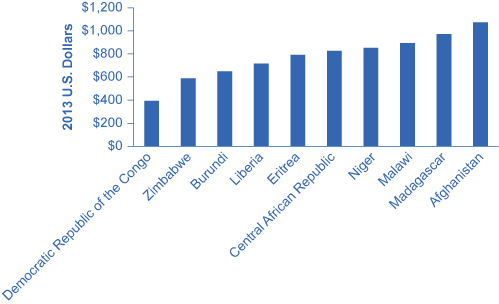
Low-income countries are at a disadvantage considering any incomes received are spent immediately on necessities such equally food. People in these countries alive on less than $ane,035 per year, which is less than $100 per month. Lack of saving means a lack of capital accumulation and a lack of loanable funds for investment in physical and human majuscule. Recent research past two MIT economists, Abhijit Bannerjee and Esther Duflo, has confirmed that the households in these economies are trapped in low incomes because they cannot muster enough investment to push button themselves out of poverty.
For example, the average citizen of Republic of burundi, the lowest-income country, subsists on $150 per year (adjusted to 2005 dollars). According to data collected by the Central Intelligence Agency in its CIA Factbook, as of 2013, 90% of Burundi's population is agrarian, with coffee and tea as the main income producing crop. Just one in ii children attends schoolhouse and, as shown in Figure three, many are not in schools comparable to what is constitute in developed countries. The CIA Factbook also estimates that fifteen% of Republic of burundi's population suffers from HIV/AIDS. Political instability has made it difficult for Burundi to make significant headway toward growth, equally verified past the electrification of only 2% of households and 42% of its national income coming from foreign assistance.

The World Factbook website is loaded with maps, flags, and other data about countries across the globe.

Other low-income countries share similar stories. These countries have plant information technology difficult to generate investments for themselves or to notice foreign investors willing to put up the coin for more the basic needs. Foreign assistance and external investment comprise significant portions of the income in these economies, but are not sufficient to let for the capital accumulation necessary to invest in concrete and man capital letter. But is foreign aid always a contributor to economic growth? It tin be a controversial upshot, as the next Clear information technology Up feature points out.
Does foreign aid to low-income countries work?
According to the Organization of Economic Cooperation and Development (OECD), about $134 billion per year in foreign aid flows from the high-income countries of the earth to the low-income ones. Relative to the size of their populations or economies, this is not a large amount for either donors or recipients. For low-income countries, aid averages nigh 1.3 percent of their Gross domestic product. But even this relatively small-scale amount has been highly controversial.
Supporters of additional strange help point to the extraordinary homo suffering in the depression-and middle-income countries of the earth. They encounter opportunities all beyond Africa, Asia, and Latin America to set up health clinics and schools. They want to aid with the job of building economic infrastructure: clean h2o, plumbing, electricity, and roads. Supporters of this help include formal state-sponsored institutions like the United Kingdom'south Section for International Development (DFID) or contained non-governmental organizations (NGOs) like CARE International that also receive donor government funds. For example, because of an outbreak of meningitis in Federal democratic republic of ethiopia in 2010, DFID channeled significant funds to the Ethiopian Ministry of Wellness to train rural wellness care workers and also for vaccines. These monies helped the Ministry offset shortfalls in their budget.
Opponents of increased aid do not quarrel with the goal of reducing human suffering, only they suggest that foreign help has frequently proved a poor tool for advancing that goal. For case, according to an article in the Attaché Journal of International Affairs, the Canadian foreign aid organization (CIDA) provided $100 one thousand thousand to Tanzania to grow wheat. The project did produce wheat, but nomadic pastoralists and other villagers who had lived on the state were driven off 100,000 acres of country to make way for the project. The harm in terms of man rights and lost livelihoods was significant. Villagers were beaten and killed because some refused to go out the land. At times, the unintended collateral impairment from foreign help can be significant.
William Easterly, professor of economic science at New York University and author of The White Man'due south Brunt, argues that aid is often given for political reasons and ends upward doing more harm than good. If the government of a land creates a reasonably stable and market-oriented macroeconomic climate, and then strange investors volition exist likely to provide funds for many assisting activities. For instance, co-ordinate to The New York Times, Facebook is partnering with multiple organizations in a projection called Internet.org to provide admission in remote and low-income areas of the world, and Google began its ain initiative called Project Loon. Facebook'south first forays into providing Internet access via mobile phones began in stable, market-oriented countries like India, Brazil, Republic of indonesia, Turkey, and the Philippines.
Policymakers are at present wiser almost the limitations of strange help than they were a few decades ago. In targeted and specific cases, especially if strange aid is channeled to long-term investment projects, strange aid can take a modest role to play in reducing the extreme levels of deprivation experienced by hundreds of millions of people around the earth.
Watch this video on the complexities of providing economical assistance in Africa.

Fundamental Concepts and Summary
The fundamentals of growth are the same in every country: improvements in man capital, physical majuscule, and engineering science interacting in a marketplace-oriented economy. Countries that are loftier-income tend to focus on developing and using new technology. Countries that are middle-income focus on increasing human capital and becoming more connected to applied science and global markets. They have charted unconventional paths by relying more than on state-led back up rather than relying solely on markets. Depression-income, economically-challenged countries have many health and human development needs, but they are as well challenged by the lack of investment and foreign assistance to develop infrastructure like roads. There are some vivid spots when information technology comes to financial development and mobile communications, which suggest that low-income countries tin become technology leaders in their own correct, but it is besides early to claim victory. These countries must do more to connect to the rest of the global economy and detect the technologies that work all-time for them.
Cocky-Check Questions
- Create a tabular array that identifies the macroeconomic policies for a high-income country, a heart-income land, and a low-income country.
- Utilize the data in the text to contrast the policy prescriptions of the loftier-income, heart-income, and low-income countries.
Review Questions
- What other factors, aside from labor productivity, capital investment, and technology, impact the economic growth of a state? How?
- What strategies were employed by the Eastward Asian Tigers to stimulate economical growth?
Critical Thinking Questions
- Explain why is it difficult to set aside funds for investment when you are in poverty.
- Why do you think it is hard for loftier-income countries to accomplish loftier growth rates?
Problems
- Use the Rule of 72 to guess how long it will take for India, Spain, and South Africa to double their standards of living.
- Using the enquiry skills you take acquired, recall the following data from The World Bank database (http://databank.worldbank.org/data/dwelling.aspx) for Republic of india, Spain, and Southward Africa for 2008–2013, if available:
- Telephone lines
- Mobile cellular subscriptions
- Secure Cyberspace servers (per ane million people)
- Electricity production (kWh)
Set up a chart that compares these three countries. Describe the key differences between the countries.
References
"Shinzo Abe's Government Looks Likely to Disappoint on Fiscal Consolidation." The Economist, May 4, 2013. http://world wide web.economist.com/news/finance-and-economics/21577080-shinzo-abes-authorities-looks-likely-disappoint-fiscal-consolidation-dont.
Banerjee, Abhijit V., and Esther Duflo. Poor Economics. "About the Volume: Overview." http://pooreconomics.com/about-book.
Care International. "About United states of america." Accessed Jan xiv, 2014. http://www.care-international.org/about-us.aspx.
Central Intelligence Bureau. "The World Factbook: Africa, Republic of burundi." Last modified November 12, 2013. https://www.cia.gov/library/publications/the-world-factbook/geos/by.html.
Central Intelligence Agency. "The World Factbook: Africa, Democratic Congo-brazzaville." Last modified November 12, 2013. https://www.cia.gov/library/publications/the-world-factbook/geos/cg.html.
Easterly, William. The White Man'south Burden: Why the West's Efforts to Aid the Rest Take Washed Then Much Sick and So Piddling Good. Penguin Group (U.s.), 2006.
Goel, Vindu. "Facebook Leads an Endeavour to Lower Barriers to Internet Access," The New York Times. Terminal modified August xx, 2013.
Google. "Projection Loon." http://www.google.com/loon/.
GOV.Great britain. "Section for International Development." https://www.gov.uk/government/organisations/department-for-international-development.
The Earth Bank. "Millennium Evolution Goals." http://www.worldbank.org/mdgs/.
Todaro, Michael P., and Stephen C Smith. Economic Development (11th Edition). Boston, MA: Addison-Wesley: Pearson, 2011, chap. 3.
Vercillo, Siera. "The Failures of Canadian Foreign Assistance: Tied, Mismanaged and Uncoordinated." The Attaché Periodical of International Affairs. (2010). http://theattachejia.files.wordpress.com/2013/10/the-attache-2010-event.pdf.
Glossary
- E Asian Tigers
- the economies of Taiwan, Singapore, Hong Kong, and Due south Korea, which maintained loftier growth rates and rapid export-led industrialization between the early 1960s and 1990 allowing them to converge with the technological leaders in high-income countries
- growth consensus
- a serial of studies that show, statistically, that 70% of the differences in income per person across the world is explained by differences in physical capital (savings/investment)
- high-income country
- nation with a per capita income of $12,475 or more than; typically has high levels of homo and concrete capital
- low-income state
- a nation that has a per capita income of less than $ane,025; a third of the globe's population
- center-income country
- a nation with per capita income between $i,025 and $12, 475 and that has shown some power, even if not always sustained, to take hold of up to the engineering leaders in loftier-income countries
Solutions
Answers to Self-Cheque Questions
- The following table provides a summary of possible answers.
High-Income Countries Middle-Income Countries Low-Income Countries - Foster a more educated workforce
- Create, invest in, and apply new technologies
- Adopt fiscal policies focused on investment, including investment in human capital, in engineering, and in physical plant and equipment
- Create stable and market-oriented economic climate
- Use monetary policy to keep inflation depression and stable
- Minimize the risk of exchange charge per unit fluctuations, while also encouraging domestic and international contest
- Invest in technology, human capital, and concrete capital
- Provide incentives of a market-oriented economic context
- Piece of work to reduce regime economical controls on market activities
- Deregulate the banking and fiscal sector
- Reduce protectionist policies
- Eradicate poverty and extreme hunger
- Attain universal chief education
- Promote gender equality
- Reduce child mortality rates
- Ameliorate maternal health
- Combat HIV/AIDS, malaria, and other diseases
- Ensure ecology sustainability
- Develop global partnerships for development
Table 6. - Low-income countries must prefer government policies that are market-oriented and that educate the workforce and population. Afterward this is washed, depression-income countries should focus on eradicating other social ills that inhibit their growth. The economically challenged are stuck in poverty traps. They demand to focus more on wellness and pedagogy and create a stable macroeconomic and political environment. This will concenter foreign help and foreign investment. Middle-income countries strive for increases in concrete capital and innovation, while higher-income countries must work to maintain their economies through innovation and engineering science.
Source: https://opentextbc.ca/principlesofeconomics/chapter/32-2-improving-countries-standards-of-living/
0 Response to "what can low income countries do in order to increase the amount of loanable funds"
Post a Comment